Bittihn Group · MPI-DS Göttingen
Emergent Dynamics in Living Systems
We study how collective behavior emerges from the physical interactions of individual cells combined with internal regulatory processes and environmental feedback — building theory and simulations that connect single cells to the dynamics of colonies, tissues, and tumors. We work at the interface of physics and biology using the methods of statistical physics, active matter, nonlinear dynamics, and quantitative biology.
We are located at the department of Living Matter Physics at the Max Planck Institute for Dynamics and Self-Organization in Göttingen. Our group is part of the MSCA Doctoral Network CAFE-BIO and the StatMemBio initiative.
Research directions
All research →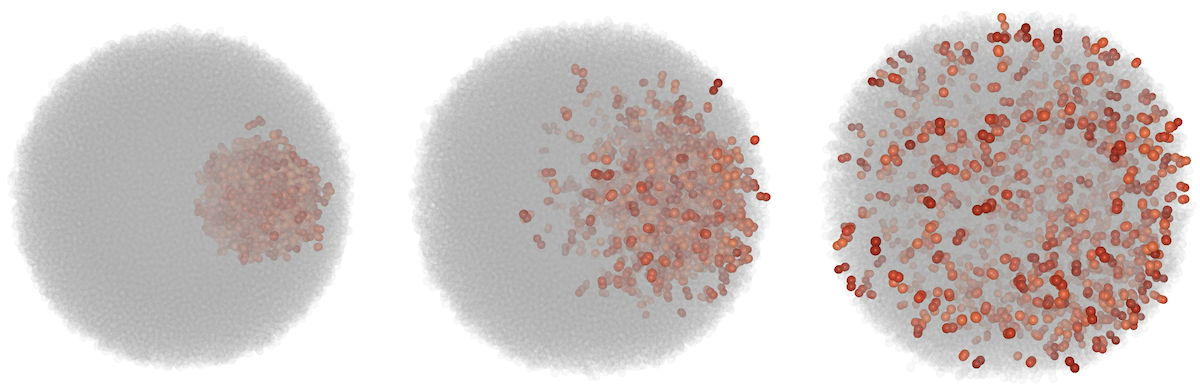
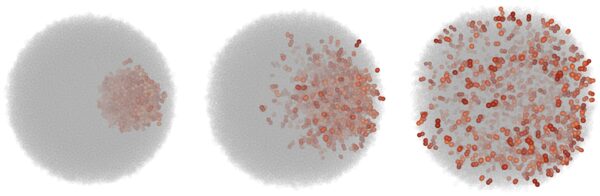
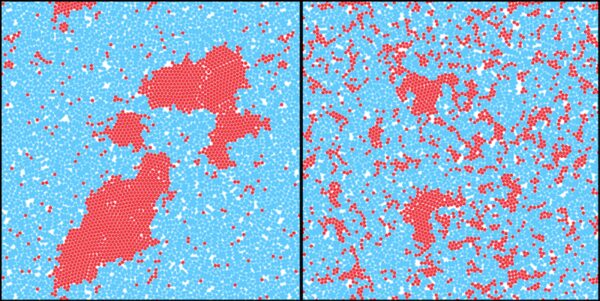
Statistical mechanics of proliferation
Cell division is one of the most fundamental activities of life, yet the collective physics it generates is far less understood than motility-driven active matter. We build a statistical-physics description of growing, dividing tissues, uncovering sharp transitions in mixing, phase separation, and mechanical competition — with direct relevance to tumor invasion and tissue mechanics.
Read more →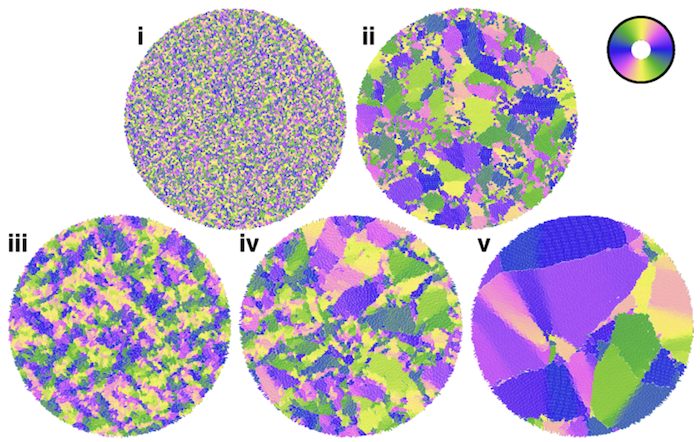
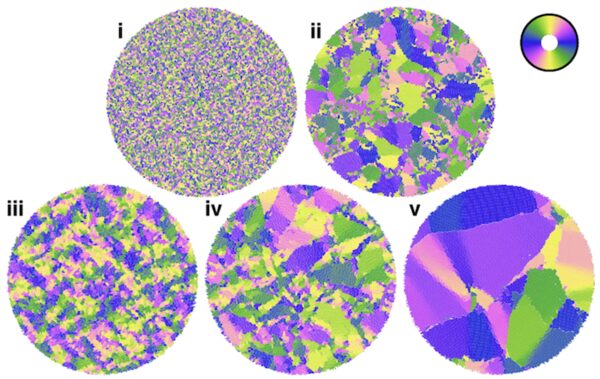
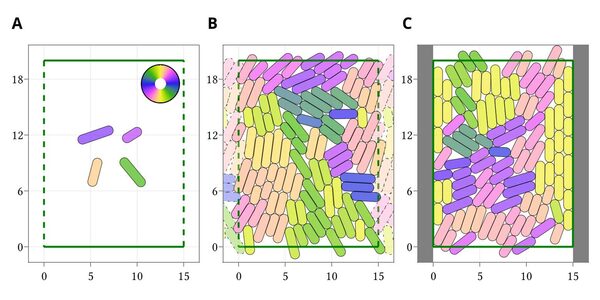
Orientational order and mechanical self-organization
When cells grow, divide and move in confinement, they can self-organize into ordered, nematic patterns. Using large-scale simulations, we show how growth-induced stresses, cell shape, and confinement geometry can be used to predict and control this orientational order.
Read more →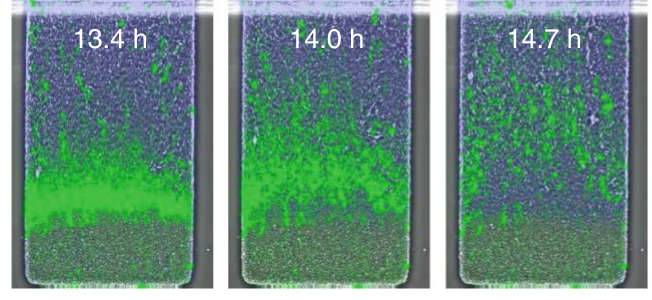
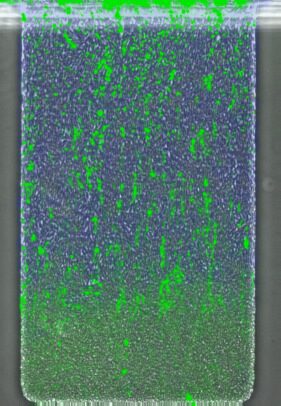
Control, patterns, and resistance in bacterial populations
Bacteria coordinate through chemical signals, mechanical forces, and metabolic gradients. Combining synthetic biology with quantitative modeling, we study population-level oscillations, spatial metabolic patterns, and how these shape antibiotic resistance and evolutionary dynamics.
Read more →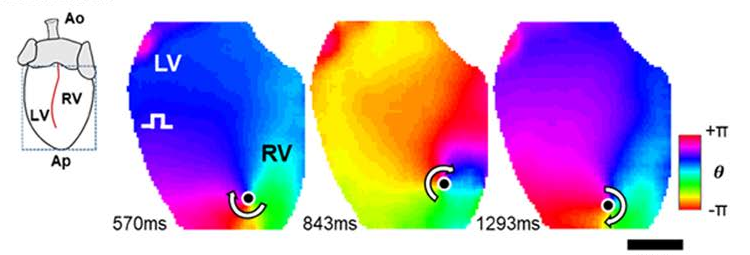
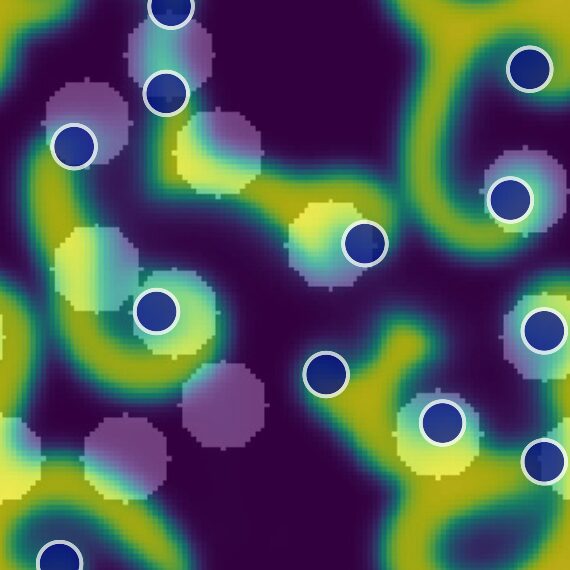
Dynamics and control of cardiac excitable media
The heart is an excitable medium in which rotating spiral waves drive life-threatening arrhythmias. Our work established how curved tissue boundaries nucleate waves under electric fields — the basis for low-energy defibrillation — and continues through collaborations on the dynamics and control of fibrillation.
Read more →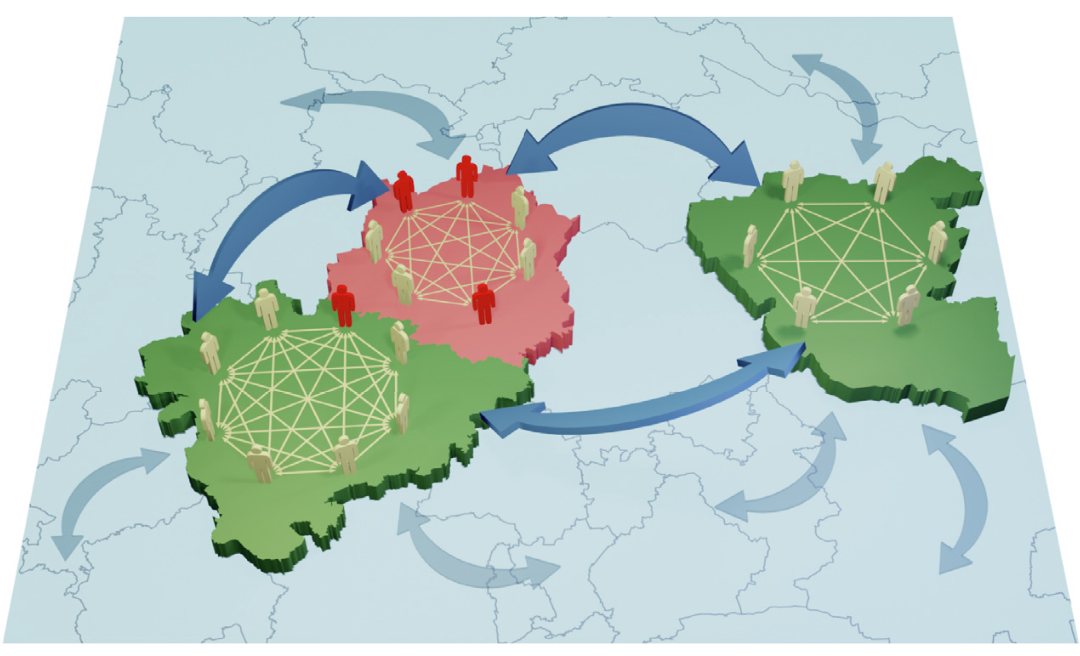
Epidemic dynamics: Stochastic spreading and spatial control
Epidemic models often ignore spatial structure and stochastic fluctuations, yet these decide whether local outbreaks grow into pandemics. We showed that population subdivision reshapes outbreak probabilities and that geographically targeted measures can contain an epidemic with far fewer total restrictions.
Read more →Latest News
All news →Philip receives the R. W. Pohl medal for outstanding teaching
Philip was awarded the R. W. Pohl medal for outstanding teaching in physics for the lecture "Introduction to Physics of Complex Systems."
Torben wins an IMPRS Excellence Fellowship
Torben Sunkel has been awarded a competitive Excellence Fellowship by the IMPRS for the Physics of Biological and Complex Systems — a wonderful distinction!
A minimal, mechanically consistent model of dividing cells
A minimal particle model of smoothly dividing disk-shaped cells that stays mechanically consistent through division, in npj Systems Biology and Applications.