Orientational order and mechanical self-organization
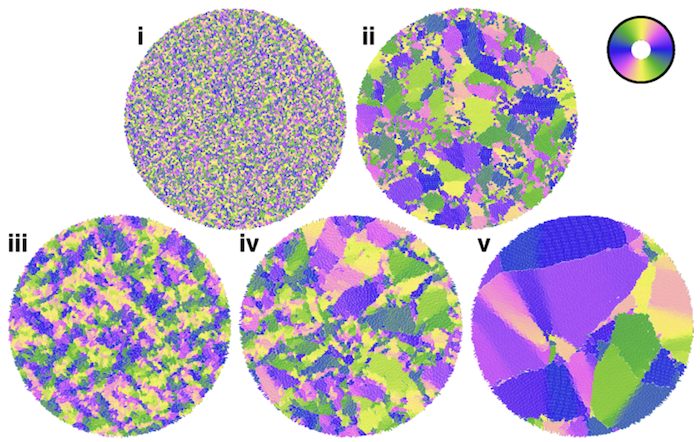
When elongated cells such as rod-shaped bacteria grow and divide, they generate both mechanical forces and orientational patterns. The feedback between cell shape, growth-driven flows, and mechanical interactions produces self-organization that standard continuum active-nematic theories fail to capture.
Using large-scale agent-based simulations we showed that confined growing rods can reach perfect global alignment, driven by growth-induced stress anisotropy, and that a subtle detail — the tip shape of a cell — is decisive for the resulting microdomain structure. We are now mapping how confinement geometry and the inheritance of division axes can be used to predict and control orientational order.
These results also point beyond biology, toward the design of self-replicating materials with programmable mechanical textures.
Selected publications
Prediction and control of geometry-induced nematic order in growing multicellular systems
L. Hupe, J. Isensee, R. Golestanian, P. Bittihn
(2025)
Order and shape dependence of mechanical relaxation in proliferating active matter
J. Isensee, L. Hupe, P. Bittihn
(2025)
Sensitive particle shape dependence of growth-induced mesoscale nematic structure
J. Isensee, P. Bittihn
Soft Matter 21, 4233 (2025)
3D multiscale shape analysis of nuclei and in vivo elastic stress sensors allows force inference
A. Jurado, J. Isensee, A. Hofemeier, L. J. Krüger, R. Wittkowski, R. Golestanian, P. Bittihn, T. Betz
Biophysical Journal 124, 2784 (2025)
Orientational lineage memory and mechanical ordering during diffusion-limited growth
I.-M. Sarris, R. Golestanian, P. Bittihn
(2025)
Collective self-caging of active filaments in virtual confinement
M. Kurjahn, L. Abbaspour, F. Papenfuß, P. Bittihn, R. Golestanian, B. Mahault, S. Karpitschka
Nature Communications 15, 9122 (2024)
Stress anisotropy in confined populations of growing rods
J. Isensee, L. Hupe, R. Golestanian, P. Bittihn
Journal of the Royal Society Interface 19, 20220512 (2022)