Statistical mechanics of proliferation
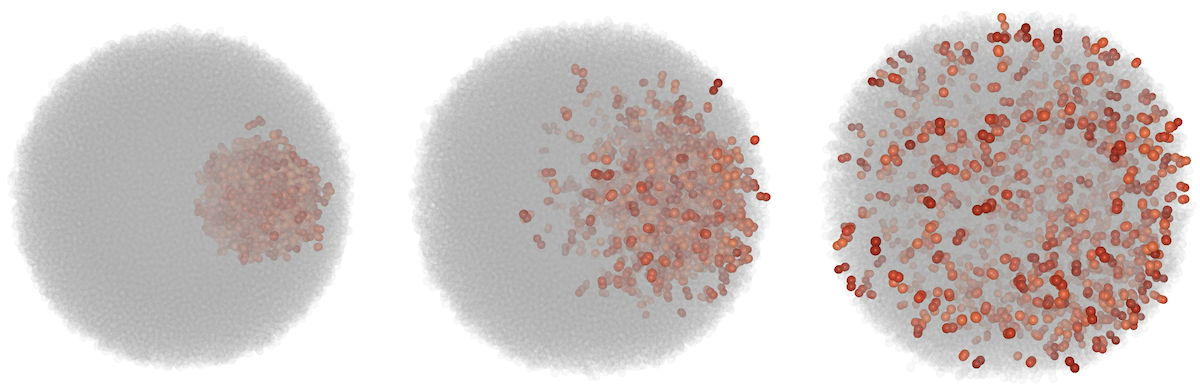
Cell division is one of the most fundamental activities of life, yet the collective physics it generates has received far less attention than motility-driven active matter. Our main focus is to establish a rigorous statistical-physics description of proliferating multicellular systems as a distinct class of active matter. Growth and division break number and volume conservation, correlate cells that share a lineage, and generate anisotropic stresses — leading to genuinely new phenomena.
In growing three-dimensional spheroids we found a sharp motility-induced mixing transition: Below a threshold, growth-driven pressure confines cell lineages; above it, cells disperse and mix. We have also uncovered growth-driven phase separation between motile and proliferating cells, a mechanical fitness metric that decides competition in homeostatic tissue, and self-similar trajectory statistics in isovolumetric (embryo-like) division.
Understanding whether a tissue is mixed or confined has direct implications for tumor invasion, therapeutic access, and the design of cell therapies.
Selected publications
A minimal mechanically consistent model of smoothly dividing disk-shaped cells
L. Hupe, Y. G. Pollack, J. Isensee, A. Amiri, R. Golestanian, P. Bittihn
npj Systems Biology and Applications 12, 91 (2026)
Phase separation in a mixture of proliferating and motile active matter
L. Hupe, J. M. Materska, D. Zwicker, R. Golestanian, B. Waclaw, P. Bittihn
Physical Review Research 8, L022012 (2026)
Motility-induced mixing transition in exponentially growing multicellular spheroids
T. Sunkel, L. Hupe, P. Bittihn
Communications Physics 8, 179 (2025)
Dimensionality and confinement reshape competition in cellular renewing active matter
P. Zimmer, P. Bittihn, Y. G. Pollack
(2025)
A competitive advantage through fast dead matter elimination in confined cellular aggregates
Y. G. Pollack, P. Bittihn, R. Golestanian
New Journal of Physics 24, 073003 (2022)