Epidemic dynamics: Stochastic spreading and spatial control
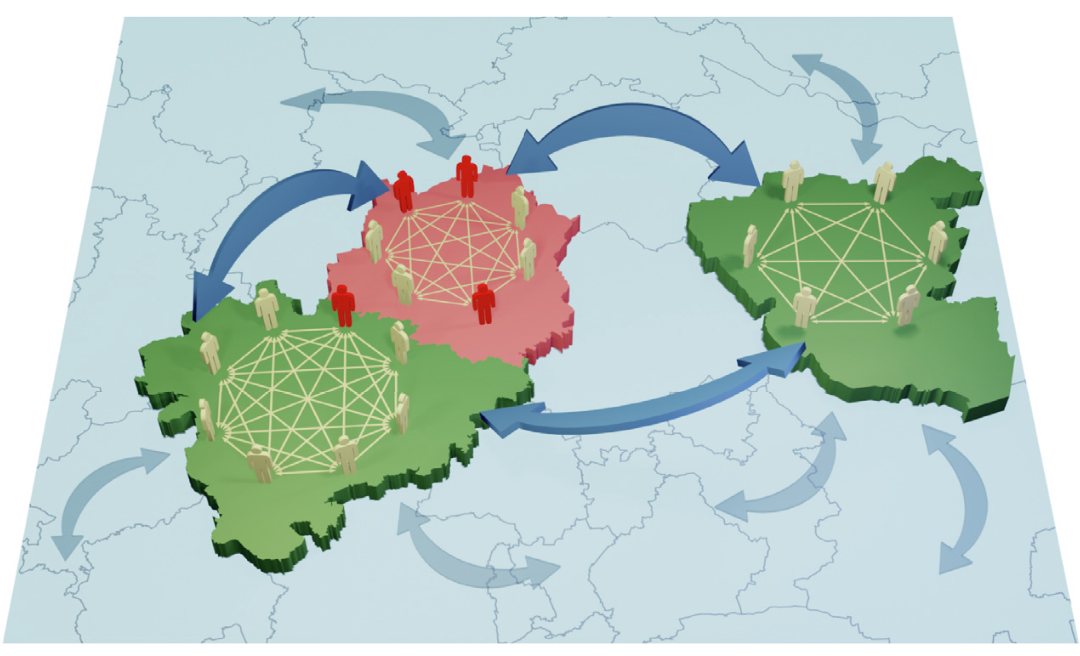
Epidemic models often ignore spatial structure and stochastic fluctuations — yet these features decide whether local outbreaks grow into pandemics. Applying tools from nonlinear dynamics and stochastic spatial systems, we found that population subdivision reshapes outbreak probabilities in ways deterministic models miss.
Building on this, we showed that geographically targeted restrictions can suppress an epidemic at least as effectively as uniform measures while requiring far fewer total restrictions, through a cooperative buffering effect — providing quantitative support for adaptive, localised response strategies. Both studies were released together with open-source simulation and analysis code.
Selected publications
Local measures enable COVID-19 containment with fewer restrictions due to cooperative effects
P. Bittihn, L. Hupe, J. Isensee, R. Golestanian
EClinicalMedicine (The Lancet) 32, 100718 (2021)
Stochastic effects on the dynamics of an epidemic due to population subdivision
P. Bittihn, R. Golestanian
Chaos 30, 101102 (2020)